


Walk into St Magnus Cathedral on a bright afternoon and the colour that falls across the red sandstone looks as though it has always been there. It has not. For most of the cathedral’s eight and a half centuries its windows held plain glass, and almost everything you see now was made within the span of a single lifetime.
The oldest glass, 1886
The earliest stained glass in the building dates from 1886 and stands in the north nave aisle. It shows the Old Testament prophet Elijah, and it is dedicated to the Reverend Charles Clouston, Minister of Sandwick. It was made by the Edinburgh firm of Ballantine and Gardiner.
Two more Ballantine and Gardiner windows followed, both in the south choir aisle. The Good Samaritan of 1898 is dedicated to Thomas Peace, of the drapers Peace and Low. The Sower, of 1904, is dedicated to B H Hossack, author of Kirkwall in the Orkneys.
Douglas Strachan, 1912
Also in the north nave aisle is a window by Douglas Strachan, among the most celebrated Scottish stained glass artists of his generation and best known for his work in the Scottish National War Memorial at Edinburgh Castle. His window here, made in 1912, shows the boy Christ called to his mission.
It is dedicated to Sir James David Marwick. His son James went on to found the accountancy firm that in time became KPMG, where the M still stands for Marwick.
The east window, 1918 to 1919
The east window was made by James Ballantine II across two years, 1918 and 1919. Its dedication reads: to the Glory of God and in memory of George Hunter MacThomas Thoms, Sheriff and Vice Admiral of Orkney and Zetland and Sheriff of Caithness, Orkney and Shetland, 1870 to 1899. Thoms had died in 1903.
The name will be familiar to anyone who knows the cathedral’s recent history. It was the Thoms Bequest that funded the restoration programme of 1913 to 1930, and it was that programme which filled most of these windows with colour in the first place.
Oscar Paterson’s workshop
Every other window in the building comes from a single source. The glass in the nave, choir, chapel, triforium, clerestory and transepts was made in the Glasgow workshop of Oscar Paterson, who was assisted by Alexander Walker, whose wife was Orcadian. The work was spread across the 1910s and 1920s, over a number of years rather than in one campaign.
It is an unusual thing for a cathedral. Most great churches accumulate their glass in fragments over centuries, from many hands. St Magnus received most of its colour from one workshop within about fifteen years, which is part of why the interior holds together as well as it does.
The last plain window
One window was left out. The great west window kept its clear glass for another half century, until 1987, when it was filled to mark 850 years since the founding of the cathedral. It was designed by Crear McCartney, paid for by donations from across Orkney and beyond, and unveiled by Queen Elizabeth II.
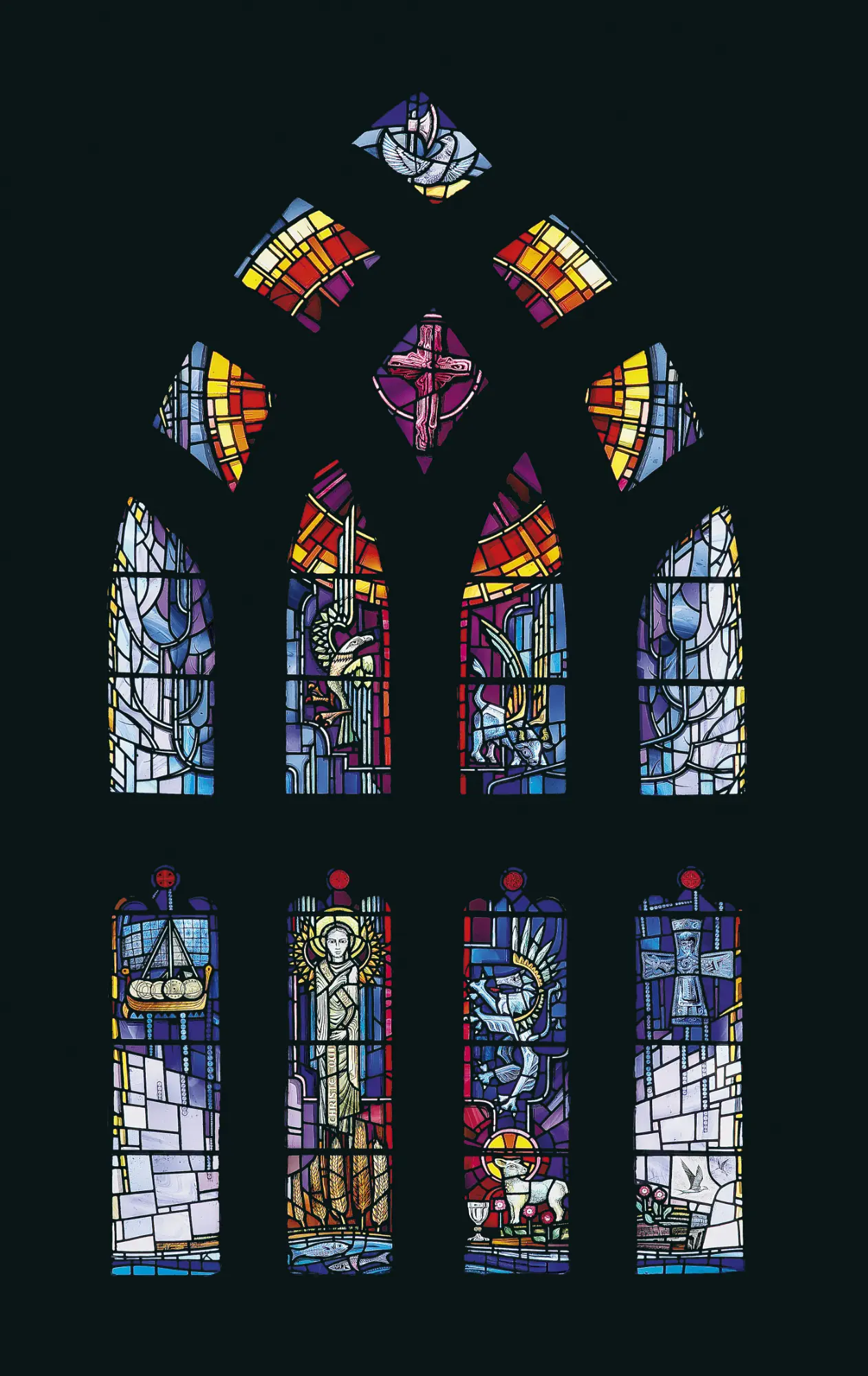
The theme of the window is Light, both physical and metaphysical, and the design exploits the splendours of Light that I associate with Orkney.
Crear McCartney
You can read more about it on our page for the West Window.
Keeping it
Glass needs looking after. The Friends funded the reconstruction of the rose window in the south transept, and the maintenance of the stained glass is among the Society’s continuing commitments. Early twentieth-century windows have been repaired by the monks at Pluscarden, the same workshop where Crear McCartney learned his craft. In 2022, as part of the work on the new vestibule, the west window itself was cleaned inside and out and a damaged pane repaired by Rainbow Glass Studios of Prestwick.
A little over a century separates the Elijah window from the west window. Everything between belongs to that span, and all of it needs keeping.
With thanks to Fran Flett Hollinrake for the research behind this article. We hope to add photographs of the individual windows in due course.


