


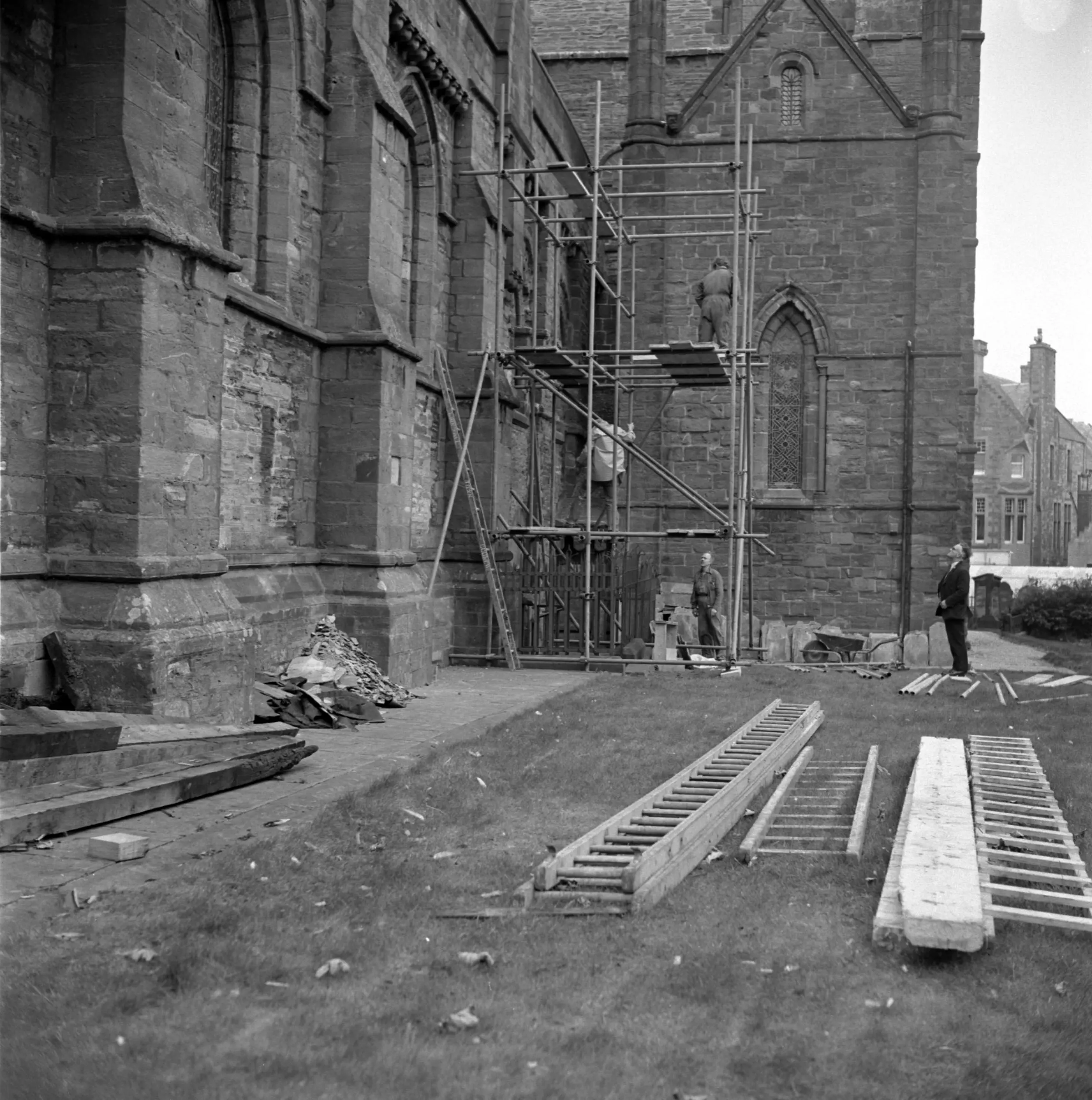

The Society of The Friends of St Magnus Cathedral was formed in the autumn of 1958, in a year when Orkney was already thinking hard about its cathedral. That August marked eight hundred years since the death of Earl Rognvald, who founded the building, and the commemoration gave a long-discussed idea the push it needed.
A scheme is afoot
The first public mention came in April 1958. At the monthly meeting of Kirkwall Town Council, Provost James Scott suggested forming a society of friends to help raise funds for the upkeep and preservation of the cathedral. The Orcadian reported that “a scheme is afoot", and a small committee was appointed to meet the Kirk Session and take the idea further: the Provost, Bailies A. Mackay and E. Eunson, and Dean of Guild Miss Reid. The model they had in mind was the Friends of Greyfriars Kirk in Edinburgh, and when the committee met on 27 May it had a copy of the Greyfriars constitution in front of it.
The reason was money, and the Provost was candid about it. The cathedral had belonged to the people of Kirkwall since 1486, when James III granted it to the town, and the town had kept it going for nearly five centuries on whatever funds could be found. Early in the twentieth century Sheriff Thoms had left a bequest of £70,000, most of which had been spent on the great restoration before and after the First World War. Of that sum, £9,000 had been set aside as a capital fund for heating, lighting, maintenance and a caretaker. It had seemed ample. By 1958 rising costs had eaten into it, the fund had shrunk to £5,000, and annual spending was outrunning the income from investments. Heating alone was costing £400 a year.
The public meeting, September 1958
Two days after the octocentenary service, on Tuesday 2 September 1958, about forty people gathered in Kirkwall Town Hall. On the platform sat Provost Scott, the Rev. John M. Rose, minister of the cathedral, the two Bailies and the Town Clerk, Mr E. J. Hendry. Mr Rose had just been invited to preach before the Queen at Crathie, and the Provost opened by wishing him a pleasant weekend at Balmoral.
Provost Scott then set out the case. He recalled the challenges to Kirkwall’s ownership of the building, from the Crown and from the Church of Scotland, and how the Town Council had seen each one off. He explained the state of the Thoms fund. He hoped a society would raise money through members’ subscriptions, bequests and other means, and he had the full support of the minister and Kirk Session.
Mr Rose gave three reasons of his own. The first was simply that people would want such a society whether or not there were funds to raise. The second was what he called “the pull of home": wherever one went in the world one met Orcadians, and when they thought of home the picture in their minds was Kirkwall and the cathedral. A society would cement that bond between Orcadians at home and abroad. The third was stewardship. Those who had gone before had handed the building on in good order, and the question now was what it would be like in a hundred years’ time.
Mr R. L. Johnson of Kirkwall moved that the Society be formed, seconded by Mr R. G. Bain of Hall of Tankerness. Speaking to his motion, Mr Johnson warned that the Society would stand or fall by its publicity, and that its aims must be made known throughout the world. The motion was carried unanimously. Application forms were to be had from the Town Clerk, and the suggested subscriptions were ten shillings a year for members, half a crown for juniors, and ten guineas for life.
The first members and office-bearers
The first General Meeting of the Society was held in the Town Council Chambers on Tuesday 30 September 1958, opened with prayer by Mr Rose. All twenty-nine people present asked to be enrolled as members, and a constitution was adopted. Its shape is still recognisable today: the Provost of Kirkwall as chairman, the minister of the cathedral as vice-chairman, and a Council of twelve, four each from the Town Council, the congregation and the wider membership.
The office-bearers were Provost James Scott as Chairman and the Rev. John M. Rose as Vice-Chairman, with R. G. Bain and D. L. Kemp as joint Honorary Secretaries and Treasurers. The Honorary Presidents were a roll-call of mid-century Orkney: Ex-Provost James Flett, the artist Stanley Cursiter, Ex-Provost P. C. Flett, Harold R. Leslie QC, Miss A. Walker and Dr Hugh Marwick. The members elected the Rev. H. L. Mooney, James W. Flett, Ernest Marwick and Miss A. Johnston to the Council, and the Town Council later named Bailies Mackay and Eunson and Councillors Groat and Harrison as its four representatives.
The Council met for the first time on 2 December 1958. Its first decisions were about telling people: a guidebook to the cathedral, leaflets, approaches to the Orkney and Shetland associations, and contact with the local and national press.
A slow start
Growth was not quick. At the annual meeting in September 1960 Mr Rose told members that he would like a reserve of £100,000 and that the Society had about £1,000. Only sixty-four people in Kirkwall and twenty-five in the rest of Orkney had joined, against fifty-two in the rest of Scotland. Orkney people had been incensed whenever it looked as though the Crown or the Church might take the cathedral over, he said, but they did not seem prepared to support it. “Too many people regard St Magnus Cathedral as a museum piece and not as a living entity." The Provost agreed: Orkney could not expect others to come forward unless it was prepared to do so itself.
The message got through. By September 1962 the Society had raised £8,435 towards the cathedral’s preservation, and in November 1965 its first large gift was dedicated: the furnishings of the new St Rognvald Chapel at the east end, designed by Stanley Cursiter and paid for by the Friends. The idea of a chapel to mark the octocentenary had been raised at the very same Town Council meeting in April 1958 that first proposed the Society. Seven years later the Friends had made it real.
Everything the Society has done since, from the Save St Magnus appeal to the new vestibule, follows from that evening in the Town Hall, and from the two men who made the case: a Provost who understood the accounts, and a minister who understood the pull of home.
Sources: The Orcadian, 24 April and 4 September 1958; The Scotsman, 3 September 1960; Edinburgh Evening News, 1 September 1962; Aberdeen Press and Journal, 26 November 1965; Minutes of Kirkwall Town Council (Orkney Archives, K1/25/58) and of the Society, 1958.


