


In Progress
The Willis Organ
about this project
The Voice of the Cathedral
At the heart of St Magnus Cathedral lies one of the most powerful and inspiring voices in Orkney’s musical life, its great pipe organ. For generations, the organ has filled the Cathedral with music for worship, civic occasions, concerts and moments of reflection.
The present organ was built in 1925 by the renowned English firm Henry Willis & Sons, one of the most distinguished organ-building companies in Britain. Instruments by the Willis firm are celebrated for their rich tone and craftsmanship, and the St Magnus organ is a fine example of their work.
Unlike many cathedral organs that sit high in a gallery, the instrument at St Magnus is located at floor level behind an elegant decorative screen, designed during early twentieth-century restoration work by the architect George Mackie Watson. This placement allows the sound to travel naturally through the nave and choir, filling the cathedral with a warm and resonant tone. The pipes stand where the first builders made a semi-circular apse to hold the shrine of St Magnus, so the instrument occupies the oldest sacred ground in the building.
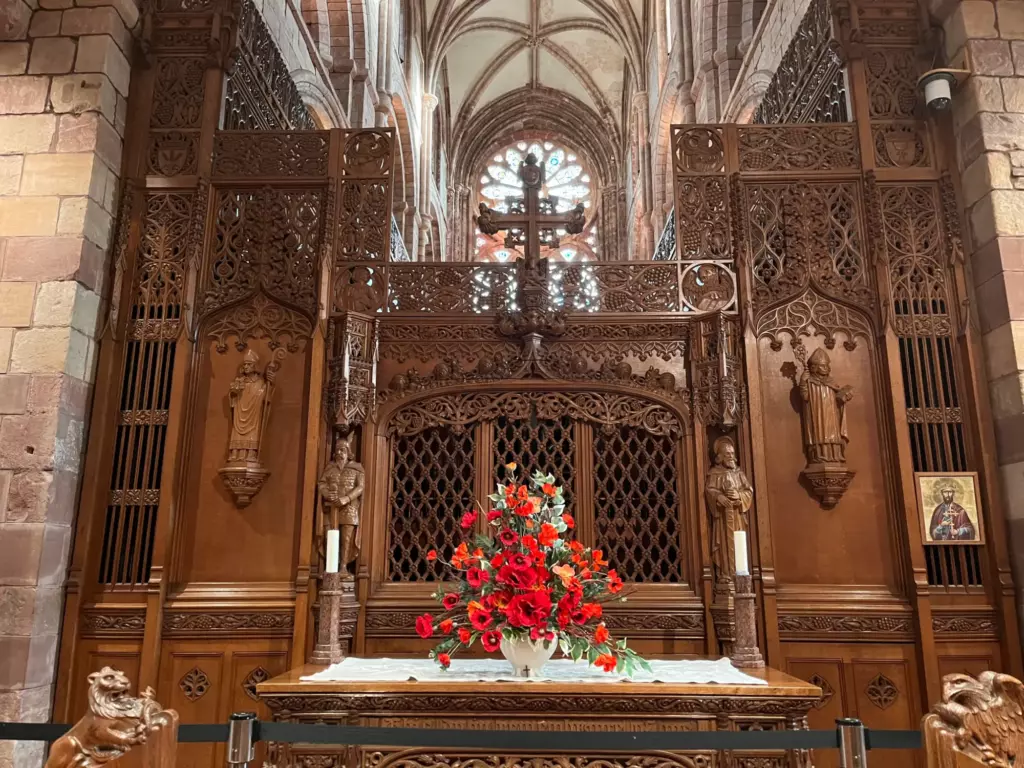
The organ was restored and tonally modernised in 1971, paid for by Kirkwall Town Council, and the work was carried out under the direction of Henry Willis IV, son of the instrument’s original builder, in consultation with the then organist Norman Mitchell. The chorus-work was realigned throughout, the Pedal Organ enlarged, and the old Choir Organ recast, its swell shutters removed and the division renamed Positif. The console, which had originally stood in the south choir aisle, was turned through 90 degrees so that the player now faces south. A solid state note switching and capture system was installed in 2001.
The result is an instrument able to carry all schools of organ music while keeping much of the character associated with British cathedral organs. Writing of it, the former cathedral organist David Drinkell singled out the very beautiful Rohr Flute in the Swell Organ, and the superb heavy-pressure Tromba, a particularly bright and majestic solo stop which soars over the full organ in no uncertain fashion. Its 16ft extension provides the Pedal Trombone.

The instrument has been carefully maintained and restored over the years to preserve both its musical character and historic fabric. This care ensures that it continues to serve the cathedral as it has for a century, leading worship, supporting the choir, and enriching concerts and cultural events held in the building.
Specification
The organ has three manuals and pedals. The specification below is the instrument as it stands today, following the 1971 rebuild.
Great Organ
- Double Open Diapason 16
- Open Diapason 8
- Stopped Diapason 8
- Principal 4
- Stopped Flute 4
- Twelfth 2 2/3
- Fifteenth 2
- Seventeenth 1 3/5
- Mixture 19.22.26.29 IV
- Tromba 8
- Swell to Great 16, 8, 4
- Positif to Great 8, 4
Swell Organ
- Geigen Diapason 8
- Rohr Flute 8
- Viola da Gamba 8
- Voix Celeste 8
- Gemshorn 4
- Principal 2
- Chorus Mixture 12.19.22 III
- Waldhorn 16
- Trumpet 8
- Hautboy 8
- Clarion 4
- Tremolo
- Octave, Sub, Unison Off
Positif Organ
- Rohrholzgedackt 8
- Dulciana 8
- Spindle Flöte 4
- Nazat 2 2/3
- Block Flöte 2
- Terz 1 3/5
- Krummhorn 8
- Tremolo
- Tromba 8
- Octave, Sub, Unison Off
- Swell to Positif
Pedal Organ
- Sub Bass 32
- Major Bass 16
- Great Diapason 16
- Bourdon 16
- Grand Principal 8
- Flute 8
- Octave 4
- Octave Flute 4
- Piccolo 2
- Trombone 16
- Waldhorn 16
- Tromba 8
- Horn 4
- Great to Pedal
- Swell to Pedal 8, 4
- Positif to Pedal 8, 4
Accessories
- Great and Pedal combinations coupled
- 0-5 pistons to each department
- Reversibles to all unison couplers, Pedal Trombone and Positif Tromba
- Octave Coupler Cancel
- General Cancel
Historical notes drawn from an account by David Drinkell, former organist of St Magnus Cathedral.
Help Protect St Magnus for Future Generations
Your membership directly funds the care and conservation of this remarkable cathedral.